

Stretching to something I’ve started this week outside the bounds of cinema but still deeply connected to creativity and story.
Please enjoy
Bry
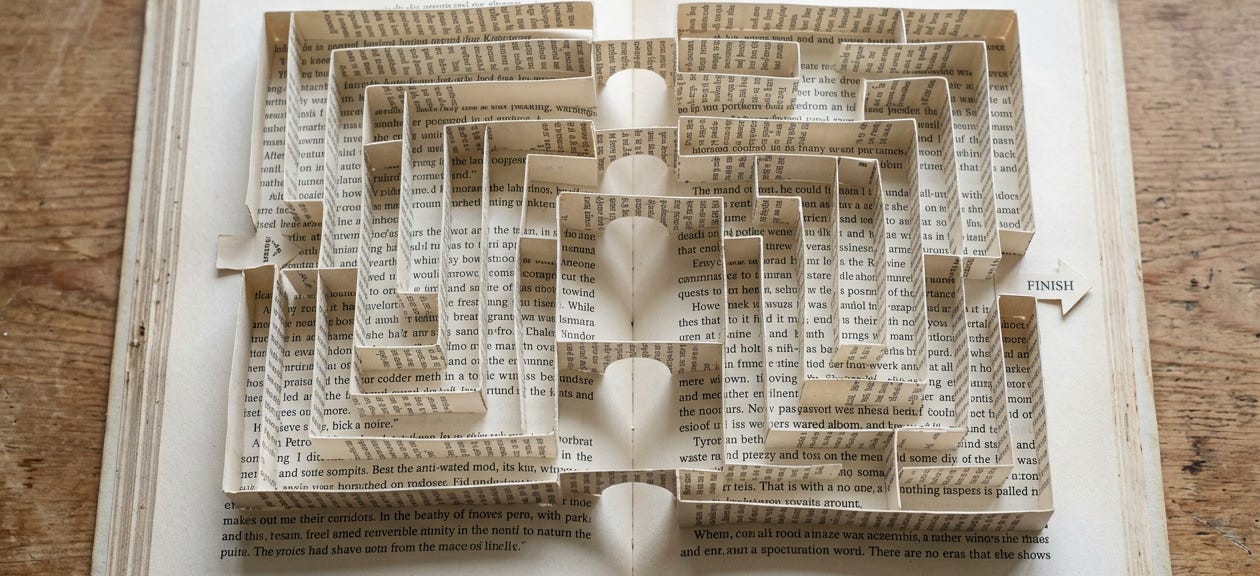
Something that always interests me, regardless of medium, is when the writer, director, artist or musician plays with the medium they’re working in. I suppose you could call it deconstructionist. It’s the kind of thing that comes to mind when I think of this great quote from Christopher Nolan.
“That’s why I say 2001 is the punk rock of movies. It’s not that it breaks all the rules. It’s a film that doesn’t acknowledge that there are any rules.”
I suppose I love the punk rock-ness of anything that doesn’t acknowledge that there are any rules. Which, I suppose, is why this book I started reading this week after years of wanting to has captured my imagination. Because it plays with ideas of what a story is, or what a book should be. Its imagination runs wild, not held back by typical narrative convention. And it has a science-fiction horror, high-concept centre to it. Released in 2000, the book is a prime example of meta-fiction, or narratives within narratives, and it’s interesting that it was being conceived around the same time as The Blair Witch Project, which came out the year before and would redefine a genre of found-footage style horror films.
House of Leaves is positioned as a book by Zampano, an elderly man whose manuscript is discovered after his death and then patched together by Johnny Truant, who writes an introduction and accompanying notes in the margins, commenting on the main narrative thrust. The central book then comments on another story, which is a documentary called The Navidson Record. Shot by an award-winning photographer and based around the house that he and his family have just moved into, it is a house which apparently defies the laws of physics by being much larger on the inside than on the outside. It also has various impossibilities, rooms that exist that shouldn’t or couldn’t be there structurally. It’s odd. I’ve just started it and it’s pulled me right in, much like the family tempted by the darkness of impossible hallways.
What’s also very cool about it is that if you flick through the book but don’t read enough to spoil anything, you’ll find that it’s very unusually laid out. There are pages and pages that are empty, or with single words. Paragraphs are arranged like architectural schematics, sentences spiral out from the centre of the page like an asterix.
It’s very cool, very inspiring. Showing us that there is no one way to tell a story, even in a medium that’s much, much older than film.